An Extended Tutorial and Vocabulary for Relational Language Design in an Era of AI-Assisted Query Generation
PVLDB 19(12): 4932-4938, 2026 (to appear)
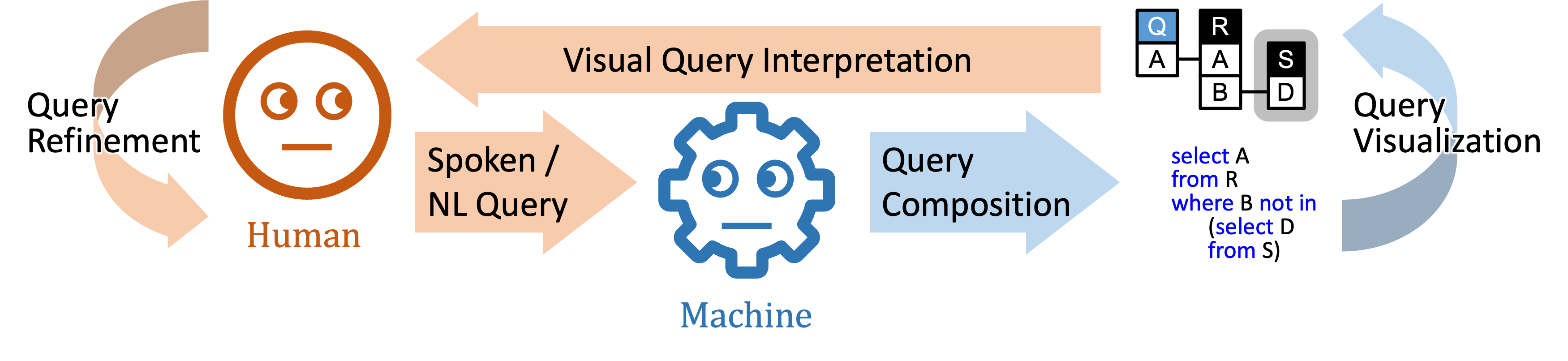
Relational query languages have been studied and used for more than 50 years, with expressive power (what a language can express) a central criterion for studying and comparing them. Yet what a language can say is only one aspect of language design. Another is how effectively a language lets us formulate, understand, and revise what we want to say. This question is especially timely as queries are increasingly generated by machines and read, verified, and revised by humans, and many new relational languages and notations are being proposed.
Good notation can make relational structure explicit, rather than requiring readers to reconstruct and retain it mentally as they work through a query (just imagine trying to follow a complicated join path in SQL...). This raises a fundamental question of language design that is both formal and empirical: Which relational structures does a language make explicit, and how does notation affect how easily queries can be generated, understood, and revised?
This tutorial develops and applies a relational language design vocabulary that distinguishes and disentangles several concepts that discussions of query languages often conflate. Rather than beginning with formal definitions, we start from a fixed set of queries and compare their realizations across various relational languages. The examples expose differences in relational pattern, semantic conventions, query mapping, and structural notation before these distinctions are formalized. To make recurring relational patterns explicit, we use Abstract Relational Calculus (ARC) and Relational Diagrams as reference representations and notional devices. The goal is to survey languages, clarify the design space, and make the comparison concrete through a set of recurring examples.
The three-hour VLDB 2026 version extends the SIGMOD 2026 tutorial with recursion and path queries, nested relational data, and relational formalisms for problems beyond PTIME. Participants will leave with a framework for comparing existing and future languages, a precise vocabulary for articulating design trade-offs, and concrete examples connecting classical database languages with newer proposals.
VLDB 2026 tutorial (3 hours, forthcoming)
SIGMOD 2026 tutorial (90 minutes, PDF, 199 pages, 11 MB):
If you spot any error in the slides, please let me know via the anonymous feedback form